

Why Addiction Affects Decision-Making More Than You Think
Addiction impacts decision-making and judgment at a neurological level, not just behaviorally. Here is a quick summary of how:
- Prefrontal cortex damage weakens impulse control and long-term planning
- Dopamine disruption rewires the brain to prioritize immediate rewards over future consequences
- Amygdala dysregulation distorts emotional responses that normally guide good choices
- Feedback processing deficits make it harder to learn from negative outcomes
- Habit-driven behavior gradually replaces deliberate, goal-directed thinking
These changes do not happen overnight. And they do not reverse overnight either.
Addiction is a profound condition that disrupts far more than physical health. It quietly erodes the mental architecture behind every decision a person makes, from routine daily choices to high-stakes professional judgments. Research shows that individuals with substance use disorders demonstrate significantly reduced activity in the ventromedial prefrontal cortex. The result is a pattern of choices that prioritize short-term relief over long-term well-being, even when the person knows better.
This is not a character flaw. It is neuroscience.
For high-functioning professionals, this cognitive erosion can be particularly disorienting. The very faculties that define professional identity become compromised in ways that are difficult to recognize from the inside.
How Addiction Impacts Decision-Making and Judgment: The Neurobiology
To understand why individuals struggling with substance use make choices that seem completely irrational to outside observers, we have to look beneath the surface. The human brain is a highly complex, interconnected network, and chronic substance exposure acts like a systemic power outage across its primary decision-making hubs.
At the center of this disruption is the prefrontal cortex (PFC), specifically the ventromedial prefrontal cortex (vmPFC) and the orbitofrontal cortex (OFC). In a healthy brain, these regions act as the “chief executive officer,” analyzing risk, projecting future consequences, and keeping impulsive urges in check.
In individuals with substance use disorders, neuroimaging reveals a starkly different reality. Studies show significantly reduced activity in the vmPFC during critical decision-making tasks. This hypo-activation directly correlates with poorer long-term planning and a distinct bias toward immediate gratification.
Furthermore, chronic substance use leads to measurable structural damage. For instance, research indicates that cocaine-dependent individuals exhibit a 5% to 11% reduction in grey matter concentration across key regions, including:
- The ventromedial prefrontal cortex
- The anterior insular cortex
- The right anterior cingulate cortex
These regions form the neural backbone for emotional processing, empathy, and executive control. When grey matter is depleted, the brain simply lacks the physical processing power required to weigh complex choices.
The amygdala, which acts as the brain’s emotional alarm system, also becomes highly dysregulated. Rather than working in harmony with the prefrontal cortex to flag potential dangers, a hyperactive amygdala under the influence of addiction sends constant, exaggerated distress signals. This overrides logical processing, forcing the individual into a survival-driven mindset where securing the substance feels like an immediate, life-or-death necessity.
The Somatic-Marker Hypothesis and Emotional Processing
Developed by neuroscientist Antonio Damasio, the somatic-marker hypothesis explains how emotional signals (somatic markers) generated in the body normally guide our decision-making. When we face a choice, our brain rapidly recalls past experiences and triggers subtle bodily sensations to steer us away from danger and toward safety.
In a healthy individual, these somatic markers act as an intuitive compass. However, in substance-dependent individuals, this emotional guidance system is severely compromised.
The somatic-marker model differentiates between two types of emotional triggers:
- Primary Inducers: Innate or learned stimuli that automatically trigger a somatic state, such as encountering an actual drug cue or a highly stressful event.
- Secondary Inducers: Thoughts, memories, or mental simulations of an experience (e.g., imagining the future consequences of a relapse), which require the vmPFC to trigger a somatic response.
In addiction, the brain becomes hyper-reactive to primary inducers (the sight, smell, or thought of the substance) while becoming largely numb to secondary inducers (the cognitive awareness of losing a job, damaging a relationship, or facing legal trouble).
This deficit is clearly demonstrated using the Iowa Gambling Task (IGT), a classic laboratory test where participants choose from high-risk decks and low-risk decks.
A majority of substance-dependent individuals fail to generate anticipatory skin conductance responses (the physiological “sweaty palms” signal of risk) before making disadvantageous choices on the IGT. This mirrors the exact behavioral patterns seen in patients with physical orbitofrontal cortex lesions. They are emotionally blind to the future consequences of their choices, choosing immediate gratification even when they logically know a decision will lead to ruin.
This emotional numbing also manifests as a blunted processing of natural reinforcers. Substance-dependent individuals frequently demonstrate a flattened emotional response to both pleasant and unpleasant natural images (such as beautiful landscapes or family scenes), scoring them as significantly less positive or negative compared to healthy controls. When natural life events no longer register emotionally, the brain’s ability to make balanced, value-based decisions is deeply compromised.
Dopamine, Motivation, and the Reward Circuitry
No discussion of addiction is complete without addressing dopamine, the chemical messenger of anticipation and motivation.
The brain’s reward system relies heavily on the mesolimbic dopamine pathway, which connects the ventral tegmental area to the nucleus accumbens (part of the ventral striatum). When we experience something beneficial, this pathway releases a controlled surge of dopamine, teaching the brain to repeat that behavior.
Substances of abuse, however, hijack this system, flooding the brain with dopamine levels up to ten times higher than natural rewards can produce. Over time, this massive overstimulation triggers a process known as incentive sensitization. The brain’s reward circuitry becomes hypersensitive to drug-associated cues, transforming a mild preference into an overwhelming, compulsive “wanting,” even when the actual “liking” (the pleasure derived from the substance) has drastically diminished.
As addiction progresses, two critical shifts occur in the neural circuitry:
- The Shift from Goal-Directed to Habit-Driven Behavior: Early substance use is often goal-directed. An individual makes a conscious decision to use a substance to achieve a specific feeling. The action of seeking and using the substance becomes deeply ingrained, functioning more like an involuntary reflex than a deliberate choice.
- Hedonic Allostasis: To survive the constant flood of artificial dopamine, the brain downregulates its own dopamine receptors and reduces natural chemical production. This raises the individual’s “pleasure threshold.” Activities that once brought joy no longer register. The individual enters a state of chronic emotional deficit, where they require the substance just to feel normal.
This neurochemical imbalance creates a profound motivational conflict. The rational brain is bypassed entirely, leaving the individual trapped in a loop where survival-level motivation is directed solely toward obtaining the substance.
The Three Stages of Dysfunctional Decision-Making
To understand how these neurological changes impact daily choices, it is helpful to look at decision-making as a process rather than a single event. According to a Scientific review on the stages of dysfunctional decision-making, decision-making in addiction breaks down across three distinct cognitive stages.
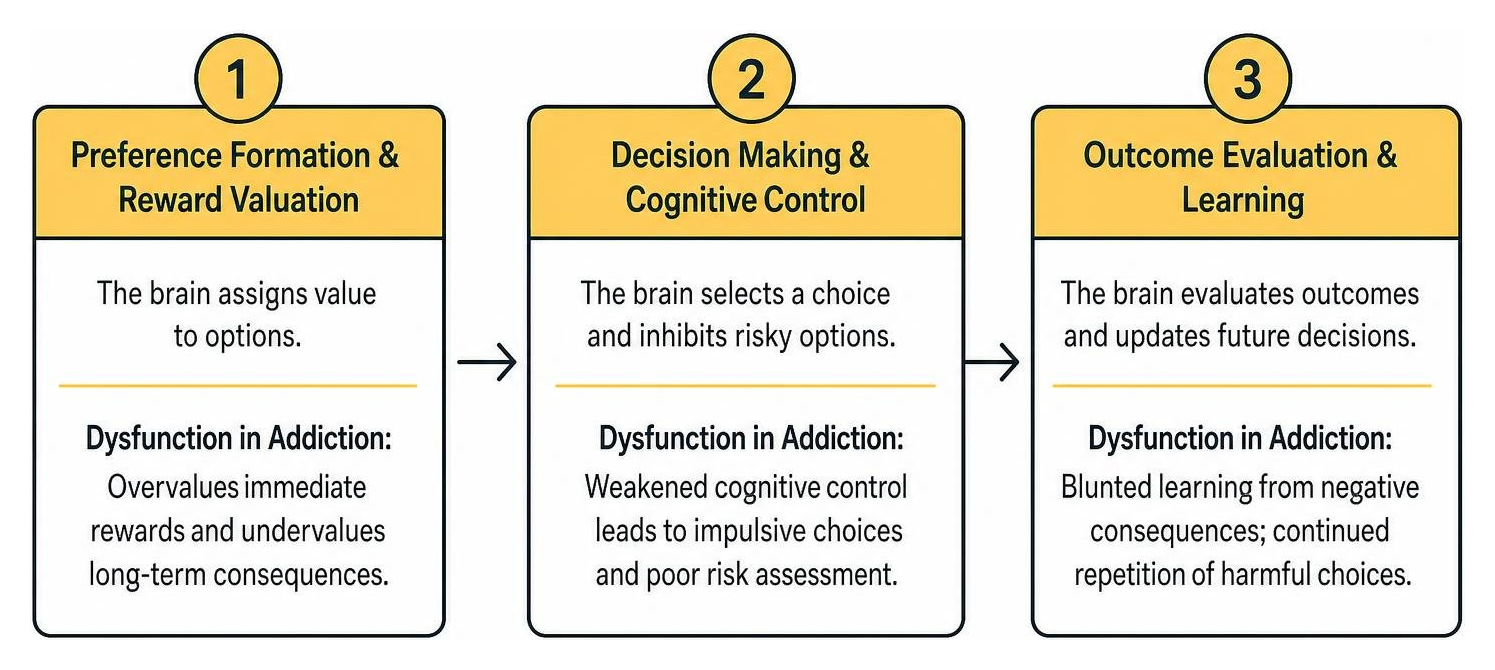
Preference Formation and Reward Valuation
The first stage of decision-making is preference formation. In a healthy brain, this valuation is balanced, weighing immediate pleasure against long-term costs.
In individuals with substance use disorders, this valuation system is heavily skewed. They exhibit a cognitive phenomenon known as delay discounting, an extreme preference for smaller, immediate rewards over much larger, delayed rewards.
For example, when presented with a choice between receiving $10 today or $100 in a month, an individual with a substance use disorder is statistically far more likely to demand the immediate $10. In real life, this translates to prioritizing the immediate, fleeting relief of substance use over long-term goals like career stability, financial health, or physical well-being.
This stage is also marked by:
- Heightened Reward Sensitivity: An exaggerated cognitive focus on the potential positive outcomes of a risky choice.
- Deficits in Probability Discounting: An inability to accurately assess the likelihood of negative outcomes, leading to hazardous risk-taking behaviors.
Choice Implementation and Self-Regulation
Once a preference is formed, the brain must execute the chosen action while actively inhibiting alternative, counterproductive urges. This stage is known as choice implementation.
For individuals in active addiction, this is where self-regulation falls apart. Even when someone genuinely wants to choose a healthy path, they struggle with impulsive action.
This deficit in response inhibition is driven by prefrontal underactivity. The brain’s “brakes” are essentially offline. When triggered by stress, environmental cues, or internal cravings, the individual executes the habit-driven behavior of substance use before the rational prefrontal cortex can intervene to stop it.
Understanding the deep connection between cognitive self-regulation and overall mental health is a vital component of sustainable healing.
Feedback Processing and Inconsistent Choices
The final stage of decision-making is feedback processing, where the brain evaluates the outcome of a choice and updates its future behavior accordingly. If a decision leads to a negative outcome, a healthy brain learns from that loss and avoids making the same choice in the future.
Addiction severely disrupts this reinforcement learning loop. Emerging research, detailed in this Research on inconsistent decision-making in addiction, suggests that individuals with substance use histories do not simply ignore negative consequences. Rather, they struggle to consistently act on the consequences they recognize.
Key insights from this research reveal that:
- Substance-dependent individuals struggle to stick with beneficial choices, even after experiencing positive outcomes.
- They exhibit highly erratic switching behavior, frequently abandoning successful strategies for risky options without a clear logical reason.
- This decision-making inconsistency is actually more pronounced in stable environments where patterns should be easy to detect and navigate.
Because their brains process feedback inconsistently, individuals with substance use disorders struggle to learn from their mistakes. They may experience severe legal, financial, or relational consequences, feel genuine remorse, and yet repeat the exact same self-destructive behavior shortly afterward because the feedback loop failed to update their subconscious choice-implementation systems.
Substance-Specific Impacts on Cognitive Judgment
While addiction broadly impairs the brain’s executive networks, different substances impact fronto-striatal and limbic circuits in unique ways.
| Substance Class | Primary Brain Regions Affected | Cognitive & Judgment Impact | Behavioral Manifestation |
|---|---|---|---|
| Stimulants (Cocaine, Methamphetamine) | Orbitofrontal, dorsolateral, insular, and parietal cortices; dopamine transporters | Severe executive dysfunction, grey matter loss, profound deficits in risk assessment under uncertainty | Slower decision-making, high-risk financial or physical behaviors, repetitive automatic habits |
| Alcohol | Prefrontal cortex, GABA/Glutamate pathways, cerebellum | Profound suppression of prefrontal control, high impulsivity, impaired spatial and temporal planning | Reckless actions under the influence, verbal or physical confrontations, inability to delay gratification |
| Opioids | Mu-opioid receptors, amygdala, habenula, insula | Emotional numbing, severe distress intolerance, hyper-sensitivity to immediate relief | Compulsive drug-seeking to avoid withdrawal, profound apathy toward long-term life responsibilities |
How Addiction Impacts Decision-Making and Judgment in Daily Life
The daily reality of how addiction impacts decision-making and judgment is particularly evident in the abuse of stimulants like cocaine and methamphetamine.
Chronic methamphetamine abusers exhibit significantly decreased activation in the orbitofrontal, dorsolateral prefrontal, insular, and inferior parietal cortices during decision-making tasks performed under conditions of uncertainty. Notably, this orbitofrontal hypo-activation is inversely correlated with the duration of drug use, meaning the longer an individual uses, the more profound their cognitive impairment becomes.
In daily life, this manifests as an inability to navigate complex, unpredictable situations. A business executive under the influence of stimulants may make highly erratic, high-risk financial decisions, completely miscalculating the likelihood of failure.
To understand the broader clinical implications of these specific cognitive deficits, refer to the Research on neurocognitive impulsivity in addiction, which outlines how stimulant-induced fronto-striatal damage accelerates the transition from recreational use to compulsive, involuntary habits.
Alcohol and Opioids: Impulsivity and Emotional Numbing
Alcohol and opioids impair judgment through different, yet equally destructive, neurochemical pathways.
Alcohol directly suppresses prefrontal cortex activity while altering GABA and glutamate neurotransmission. This chemical dampening of the brain’s executive centers leads to acute “alcohol myopia” — a state where the individual can only process immediate, highly visible cues while completely ignoring peripheral risks or future consequences. This is why individuals under the influence of alcohol frequently engage in reckless behaviors, such as driving under the influence or initiating verbal confrontations, despite possessing a clear, sober understanding of the dangers involved.
Opioids, on the other hand, act primarily on mu-opioid receptors, which are heavily concentrated in the brain’s emotional and pain-processing centers, including the amygdala and the habenula. The habenula plays a critical role in processing aversive stimuli and negative reward. When hijacked by chronic opioid use, the habenula’s signaling becomes distorted, leading to:
- A profound intolerance to physical or emotional distress.
- An intense, survival-driven focus on avoiding the agony of withdrawal.
- Severe emotional numbing, where the individual becomes entirely apathetic to natural life rewards, family relationships, or professional duties.
Because the prospect of withdrawal triggers such an intense, primal fear response, the individual’s decision-making is reduced to a single, daily objective: securing the next dose to maintain emotional and physical equilibrium. Breaking this cycle requires a highly structured, medically managed environment where the body can safely stabilize.
Psychological and Emotional Drivers of Impaired Judgment
While neurobiology provides the physical framework for understanding addiction, we must also examine the psychological and emotional landscapes that drive poor decision-making.

Emotional dysregulation is a primary driver of relapse and impaired judgment. Many individuals turn to substances as a form of self-medication to escape the weight of unhealed trauma, chronic stress, or underlying mental health conditions. When a person lacks healthy emotional regulation skills, any intense emotional state can feel completely overwhelming.
In these moments of emotional distress, cognitive processing narrows, and the brain defaults to familiar, deeply ingrained coping mechanisms. This vulnerability is heavily exploited by:
- All-or-Nothing Thinking: A cognitive distortion where a person views situations in black-and-white terms. In recovery, this often manifests as: “I had one slip-up, so my entire recovery is a failure, and I might as well keep using.” This irrational jump in logic completely ignores the progress already made and justifies continued self-destructive behavior.
- Situational Cues: Environmental triggers can trigger immediate, intense cravings. These cues bypass rational thought entirely, directly activating the hyper-sensitized amygdala and striatum to demand the substance.
- Stress-Induced Executive Shutdown: Chronic stress floods the brain with cortisol, which physically impairs prefrontal cortex function. Under high stress, even a sober individual in early recovery will experience a temporary drop in executive control, making them highly vulnerable to impulsive decisions.
Therapeutic Approaches to Restoring Cognitive Control
The most encouraging discovery in modern addiction science is that the brain is not permanently broken. Thanks to neuroplasticity, cognitive control can be restored over time.
However, this healing does not occur automatically through abstinence alone; it requires active, targeted cognitive rehabilitation and structured therapeutic support. To build a strong foundation for this healing process, individuals must implement evidence-based strategies from the very beginning of their journey.
Rebuilding Cognitive Health
Restoring the brain’s executive functions requires a multi-faceted therapeutic approach that combines behavioral therapies, mindfulness practices, and structured cognitive training.
- Cognitive-Behavioral Therapy (CBT): CBT is a highly structured, evidence-based therapy that helps individuals identify, challenge, and alter dysfunctional thought patterns and behaviors. By teaching clients to slow down, analyze their automatic assumptions, and develop rational alternative perspectives, CBT actively strengthens the prefrontal cortex’s ability to exert top-down control over impulsive urges. Meta-analytic findings show that CBT has moderate-to-large effect sizes in treating substance use disorders, helping individuals rebuild the logical frameworks needed for healthy decision-making.
- Dialectical Behavior Therapy (DBT): Originally developed to treat severe emotional dysregulation, DBT is highly effective in addiction recovery. It focuses on four key pillars: mindfulness, distress tolerance, emotion regulation, and interpersonal effectiveness. By teaching individuals how to sit with uncomfortable emotions without immediately acting on them, DBT directly addresses the “choice implementation” deficits that lead to impulsive relapse.
- Mindfulness Meditation and Neuroplasticity: Mindfulness practices train the brain to remain present and observe internal cravings or external stressors without judgment or immediate reaction. Neuroimaging studies show that regular mindfulness practice increases grey matter density in the prefrontal cortex and hippocampus while decreasing the size and reactivity of the amygdala. This physical restructuring restores balance to the brain’s decision-making circuitry, allowing individuals to make deliberate, values-based choices rather than automatic, habit-driven reactions.
- Executive Function Training: Just like physical muscles, the brain’s executive functions can be strengthened through targeted exercise. Cognitive rehabilitation programs utilize structured problem-solving tasks, memory exercises, and real-world behavioral challenges to help individuals rebuild their working memory, cognitive flexibility, and impulse control.
The first month of sobriety is a highly sensitive window for this cognitive restructuring, as the brain begins to clear chemical toxins and adjust to natural dopamine levels.
Frequently Asked Questions About Addiction and Decision-Making
Why do individuals with addiction continue to use despite severe negative consequences?
This behavior is driven by a combination of prefrontal cortex dysfunction, altered reward valuation, and feedback processing deficits. Because the ventromedial prefrontal cortex is underactive, the individual is highly insensitive to delayed punishment and struggles to emotionally project future consequences.
At the same time, their reward circuitry is hyper-sensitized to the immediate relief of the substance. Finally, because their brains process feedback inconsistently, they struggle to learn from past negative outcomes, leading to erratic, highly inconsistent choices even when they are fully aware of the potential damage.
Can the brain’s decision-making pathways fully recover after chronic drug use?
Yes. Thanks to neuroplasticity, the brain possesses an incredible capacity for cognitive healing. With sustained abstinence, professional therapy, and healthy lifestyle habits, the structural and functional abnormalities in the prefrontal cortex and reward circuitry can gradually reverse.
Grey matter concentration can rebuild, dopamine receptor sensitivity can normalize, and the logical “brakes” of the brain can be restored to full operational capacity.
How do stimulants specifically alter risk assessment compared to other substances?
Stimulants like cocaine and methamphetamine directly target the orbitofrontal cortex (OFC) and dorsolateral prefrontal cortex, leading to decreased activation in these regions during situations of uncertainty. This structural and functional impairment causes a profound miscalculation of risk.
While an opioid-dependent individual may make poor choices driven by emotional numbing and a desperate desire to avoid physical withdrawal, a stimulant-dependent individual is more likely to engage in active, high-stakes risk-taking behaviors because their brain is physically unable to accurately estimate the probability of a negative outcome.
Start Rebuilding Clarity and Control
Understanding how addiction affects decision-making is the first step toward lasting recovery. Addiction is a medical condition that disrupts the brain’s ability to think clearly, regulate emotions, and make sound decisions, not a lack of willpower. Recognizing these changes can replace shame with a path toward effective, evidence-based treatment.
At Reprieve House in Los Altos Hills, we provide private, physician-led residential detox in a discreet setting designed for professionals and others who value confidentiality. Our personalized approach supports safe withdrawal while helping restore the cognitive and emotional foundation needed for long-term recovery.
You don’t have to face addiction alone. Explore our tailored treatment programs and take the first step toward renewed clarity, focus, and freedom.